
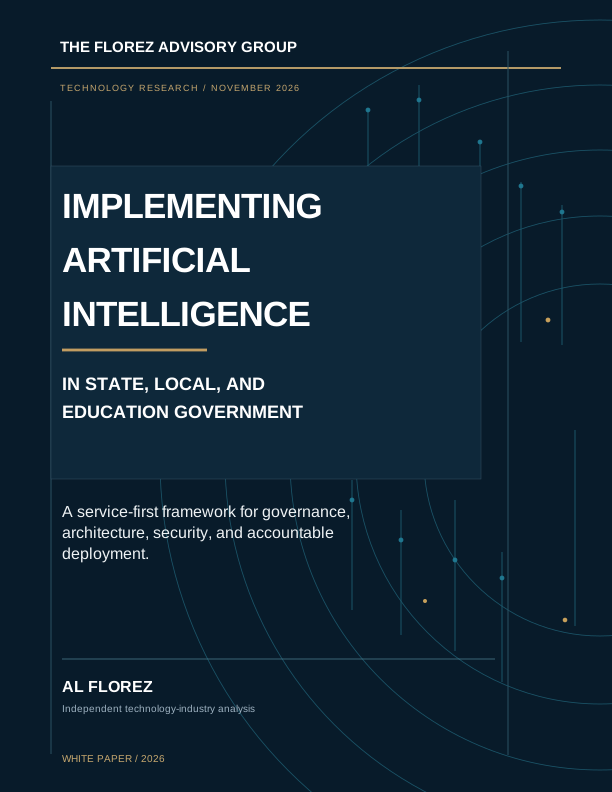
THE FLOREZ ADVISORY GROUP / TECHNOLOGY RESEARCH / NOVEMBER 2026
Implementing Artificial Intelligence in State, Local, and Education Government
A service-first framework for governance, architecture, security, and accountable deployment.
EXECUTIVE BRIEFING
Start with the public service, not the model.
Government organizations do not adopt an AI model in isolation. They change a service that already has an owner, a legal purpose, information permissions, employees, systems of record, and people affected by the result.
This paper proposes a practical decision framework for state, local, and education (SLED) organizations. It connects information rights, deployment options, application security, evaluation, and business-owner approval. The controls are proposed management methods, not a NIST certification, statutory classification, or substitute for local legal review.
May this service use the information, can it enforce boundaries, and can the organization correct the result?
WHO THIS RESEARCH IS FOR
For the people accountable after the pilot.
Government executives
Business owners weighing public purpose, risk and the authority to approve a service.
IT and security leaders
Teams responsible for architecture, identity, retrieval permissions, monitoring and recovery.
Procurement and legal reviewers
Professionals assessing suppliers, data handling, records, agreements and institutional control.
SLED technology providers
Vendors designing solutions for the operational, accessibility and governance needs of public agencies.
INSIDE THE WHITE PAPER
Decisions that belong in the implementation record.
Selected concepts from the approved publication, presented here in full context.
Information rights before retrieval
A relevant vector match is not permission to access a document. Retrieval must enforce the requesting user's entitlements before protected content enters model context.
Six deployment models, different obligations
Consumer accounts, enterprise AI SaaS, managed cloud APIs, isolated cloud, on-premises models and hybrid architectures place different duties on the agency.
Authority outside the model
Application controls, not prompts, must enforce identity, tool permissions, transaction limits and approvals for consequential actions.
Evidence before expansion
Four proposed risk tiers and a gated 90-day plan link review decisions to information sensitivity, human authority, tested outcomes and stop conditions.
THE PRACTICAL FRAMEWORK
From use case to decision record.
The paper closes with a reusable implementation decision record. It asks teams to document the intended use, data rights, system controls, hosting choice, evaluation results, review authority and the conditions for stopping or retiring a service.
Public purpose and accountable owner
Information rights and source access
Deployment choice and trust boundaries
Evaluation, cybersecurity and accessibility
Approval, rollback and continuing review
CONTENTS AT A GLANCE
Executive briefing · Public-service decisions · Information rights · Deployment models · Retrieval and action architecture · Cybersecurity · Infrastructure economics · Workforce and trust · Supplier terms · Risk tiers · 90-day release gates · Measures and recommendations · Implementation decision record
READ THE FULL PUBLICATION
Get the complete 12-page white paper.
The full paper includes the deployment comparison, architecture and control figures, risk-tier examples, a 90-day gated plan and a reusable decision record.
Independent professional analysis by Al Florez, published by The Florez Advisory Group. The proposed frameworks are management tools, not official agency policy or certification.
Request your copy
Complete the form to receive the PDF directly in your browser.
Your paper is ready.
The download should start automatically. If your browser blocked it, use the download control below. Authorization expires after ten minutes. The fallback is available for a second download attempt.
Download the PDFWe use your contact information to fulfill this request and maintain a record of the publication downloaded. Optional updates require separate consent. Read our privacy policy for retention and deletion information.
CONTINUE THE CONVERSATION
Bring the research into the room.
Explore keynote presentations, executive working sessions and independent advisory services for organizations facing the decisions described in the paper.